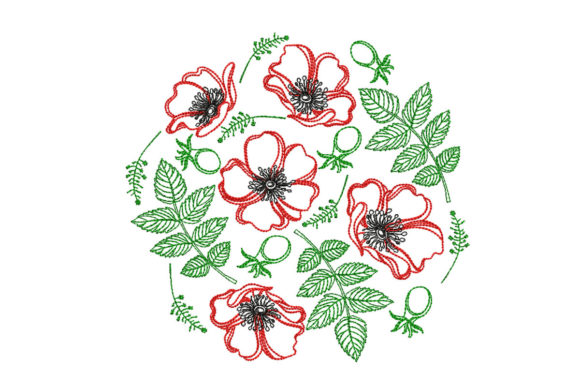
Poppy: A Thoughtful Embroidery Design for Real Projects
First Impressions: Graceful, Not Fussy
When I opened the Poppy embroidery file, what struck me wasn’t flash—it was quiet confidence. This isn’t a design shouting for attention; it’s one that settles in with intention. The blooms have gentle curves, layered petals with subtle dimension, and a natural asymmetry that avoids stiffness. There’s breathing room between elements—no overcrowded stems or forced symmetry—so it reads as botanical, not graphic. As a machine embroidery design, Poppy feels like something you’d choose for a boutique apron, not a mass-produced tote. It leans into elegance without leaning on complexity.
A Real-World Test: Embroidering a Linen Tea Towel
Last week, I stitched Poppy onto a medium-weight linen tea towel—exactly the kind I sell in my small shop. I used a lightweight cutaway stabilizer, 40-weight cotton thread, and kept the hoop size modest (5” x 7”). The result? Clean satin stitch petals, smooth fill stitch centers, and delicate running stitch stems that held their shape without pulling or shadowing. Customers who saw the finished piece commented on how “soft” and “handmade” it felt—not stiff or over-digitized. That’s Poppy working as intended: supporting the product, not competing with it.
Where Poppy Shines (and Where It Needs Care)
Poppy excels on stable, midweight fabrics: cotton poplin blouses, denim jackets, structured tote bags, and wool-blend coats. It holds up beautifully on outerwear—yes, even raincoats—as long as the stabilizer matches the weight and drape. On sweatshirts and baby onesies, I recommend testing stitch density first; dense fill areas can stiffen knit fabrics if not balanced with appropriate underlay and stabilizer choice.
Use caution on:
- Curved surfaces like caps or curved pillow covers—stems and petal tips may distort without careful hooping and stretch control;
- Thin or sheer fabrics (chiffon, voile)—the design’s detail relies on clean edge definition, so backing is non-negotiable;
- Dark fabric backgrounds—light-colored thread choices need extra contrast testing; a pale yellow poppy on navy reads differently than on cream;
- High-wash items like kitchen towels or baby clothes—verify thread colorfastness and consider reinforcing high-stress stem intersections.
Fitting Into Your Craft Business—and Your Customers’ Lives
If you’re an Etsy seller or small shop owner, Poppy is a quiet value-builder. It doesn’t scream “trendy”—it whispers “thoughtful.” That makes it ideal for personalized gifts: a monogrammed baby blanket with a single Poppy in the corner, a wedding guest book cover with three scattered blooms, or a holiday apron where the flower anchors a seasonal phrase. It reads as handmade product, not digital filler.
I’ve used Poppy in printable mockups for client pitches—and every time, it landed better than busier bouquet designs. Why? Because it leaves space for brand voice. A minimalist café can pair it with clean sans-serif typography; a heritage textile studio can layer it beside hand-drawn botanical line art. Its visual personality supports, never overwhelms.
Design Notes Every Embroidery Professional Should Check
Before stitching Poppy into your next project, take five minutes to do this:
- Test on scrap fabric—especially if using textured weaves, knits, or blends;
- Review thread color contrast in both daylight and indoor light—some pastels fade against warm-toned linens;
- Inspect small details at 200% zoom: petal edges, stem joins, and negative space between blooms;
- Confirm hoop size compatibility—this isn’t a tiny 2” motif nor a sprawling 8” statement; know its footprint;
- Try black-and-white mockups to assess silhouette strength—does the shape hold up without color cues?
- Compare performance on light vs. dark fabric in your test run;
- Use proper stabilizer: lightweight cutaway for wovens, tear-away + topping for knits;
- Verify licensing before selling finished items or bundling Poppy into digital embroidery kits—commercial use rights matter for craft businesses.
Not Just Another Bouquet Design
As part of the Bouquets category, Poppy stands out by resisting clutter. So many floral embroidery files cram in filler leaves, vines, or borders—Poppy trusts its own shape. That restraint makes it versatile across contexts: it works as a standalone embroidered patch, a subtle sweatshirt embroidery accent, or a refined detail on a tailored coat lapel. It also scales well—reduce it slightly for a cap front, enlarge gently for a pillow cover, and it keeps its grace.
For apparel decorators and custom apparel makers, Poppy adds quiet sophistication without demanding heavy digitizing adjustments. For baby embroidery or holiday embroidery, it offers warmth without cliché. And for digital embroidery file sellers, it’s a reliable anchor design—timeless enough to stay relevant across seasons, detailed enough to justify premium pricing, and flexible enough to support multiple product lines.
Final Thought: Poppy Earns Its Place
This isn’t a design you grab because it’s trending. You choose Poppy because it deepens your work—not just decorates it. It fits naturally into real-life embroidery projects: the tote bag you sew for your niece, the apron you stock at your craft fair booth, the personalized gift you ship to a loyal Etsy customer. It stitches cleanly, photographs honestly, and wears well. In a landscape full of loud, fast, and overly optimized embroidery files, Poppy reminds us that sometimes the most confident design is the one that simply knows where it belongs.