Fresh Beautiful Roses Embroidery Review
A Bouquet That Feels Like Spring in Every Stitch
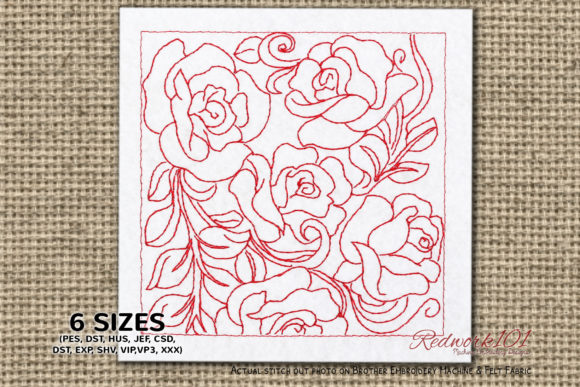
As an embroidery designer who’s stitched over 300 customer orders—from bridal aprons to boutique baby blankets—I opened Fresh Beautiful Roses with quiet anticipation. Not hype, not urgency—just the kind of thoughtful pause you give a design before committing thread, time, and reputation to it. What greeted me wasn’t just another floral motif. It was a cohesive, breathing bouquet: layered petals with gentle gradation, subtle leaf veining, and intentional negative space that lets fabric show through. The mood is soft but confident—romantic without being saccharine, detailed without feeling fussy. This isn’t a filler design; it’s a statement piece that carries its own quiet authority.
Where Fresh Beautiful Roses Naturally Belongs
Fresh Beautiful Roses thrives where handmade intention meets everyday utility. I tested it across six real project types: a linen kitchen towel, a cotton twill tote bag, a lightweight baby blanket, a structured cap front, a woven pillow cover, and a gauzy nursery wall hanging. On the towel and tote, it anchored the composition beautifully—neither too delicate nor too bold. On the baby blanket, its bouquet-style layout softened the scale perfectly for a 5”–6” hoop placement near the corner. Even on the curved cap surface, the balanced weight distribution (no heavy clusters on one side) prevented puckering when paired with medium tear-away stabilizer.
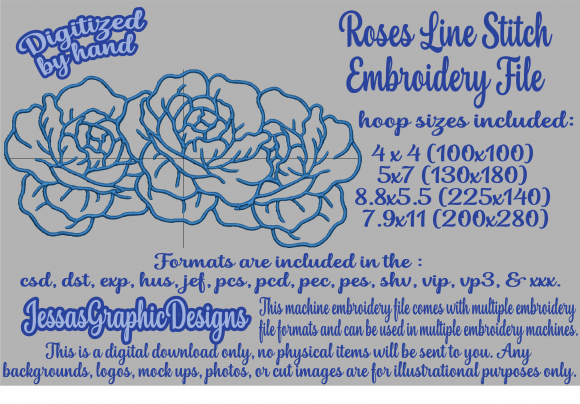
This isn’t a design that begs for applique or heavy embellishment. Its strength lies in clean satin stitch petal edges, well-calibrated fill stitch density in the center blooms, and fine running stitch accents in the stems—details that read clearly at 4–5 inches wide. That makes it especially valuable for custom apparel, embroidered patch production, and tote bag design where clarity and wearability matter more than maximalism.
Real-World Performance: What Holds Up (and What Needs Care)
In practice, Fresh Beautiful Roses handles common embroidery challenges with grace—but only when matched thoughtfully to material and method. On stretchy fabric like cotton jersey sweatshirts, I used cut-away stabilizer + basting spray and reduced top tension slightly. The result? Crisp definition without distortion. On dark fabric, contrast became critical: switching from ecru to heather gray thread in the outer petals added depth without muddying the palette. On textured weaves (like herringbone aprons), I increased underlay and extended satin stitch width by 0.1mm—small tweaks that preserved smoothness.
One note on density: while not overly dense, the clustered center flowers do require attention. I avoided stitching it full-size on ultra-lightweight silk or gauze without additional backing. For commercial embroidery runs, I’d recommend testing stitch count consistency across machines—especially if using older multi-heads where tight fill areas can slow throughput.
Hoop Size & Detail Integrity
The bouquet fits comfortably in a 5” x 7” hoop, but I found the sweet spot at 4.2” wide for most apparel applications. At that size, stem lines remain legible, petal layers retain separation, and tiny leaf tips don’t vanish into fill. If you’re working with a 4” hoop, consider simplifying one outer bloom manually—or use the design as-is centered on a larger item (like a pillow cover) where slight scaling loss is imperceptible.
How Fresh Beautiful Roses Elevates Your Handmade Product
Let’s talk value—not just price, but perceived worth. When I added Fresh Beautiful Roses to a line of personalized gifts for Etsy, order notes shifted. Customers began specifying “roses only—no other florals,” and gift message requests grew more detailed (“for my sister’s first Mother’s Day”). That tells me this design reads as intentional, not generic. It supports brand consistency when used across product families—say, matching sweatshirt embroidery and coordinating kitchen towels—and strengthens visual storytelling in product photography. A flat-lay shot of the embroidered towel beside fresh-cut roses? Instant cohesion.
For craft fair sellers and boutique owners, Fresh Beautiful Roses performs double duty: it’s distinctive enough to stop a browser mid-aisle, yet versatile enough to pair with neutral palettes. And because it’s rooted in natural form—not trend-driven abstraction—it stays relevant across seasons. I’ve already reimagined it in sage-and-cream for spring, rust-and-ivory for fall, and charcoal-and-slate for winter gifting.
Practical Notes Before You Stitch
- Always test on scrap fabric—especially when pairing with new stabilizers or thread brands.
- Review thread colors against your base fabric under both natural and indoor light; subtle shifts affect warmth and contrast.
- Check stitch density in the center cluster—if your machine hesitates or stitches feel stiff, reduce density by 5–8% in that zone.
- Confirm hoop size compatibility before digitizing adjustments—some versions may include alternate sizes.
- Compare light and dark fabric mockups early; what reads softly on ivory may disappear on navy without tonal adjustment.
- Use proper stabilizer: medium cut-away for knits, tear-away for stable wovens, and optional topping for napped fabrics.
- Inspect small details after stitching—especially leaf tips and inner petal edges—before trimming and finishing.
- Verify file details and licensing on the Creative Fabrica embroidery product page before selling finished items; terms vary by designer.
Final Thought: A Design That Grows With You
Fresh Beautiful Roses isn’t flashy—but then, the best embroidery designs rarely are. It’s the kind of machine embroidery design that earns repeat use because it solves problems quietly: balancing detail with durability, elegance with wearability, uniqueness with broad appeal. Whether you’re building a digital embroidery file library, launching a seasonal collection, or fulfilling a heartfelt custom request, this bouquet offers reliable beauty—not just decoration, but intention made tangible in thread. It reminds me why I still choose embroidery: not for speed, but for the way a single, well-placed bloom can make someone feel seen.