Woman and Flowers in One Line
A Delicate Silhouette That Speaks Before the Needle Moves
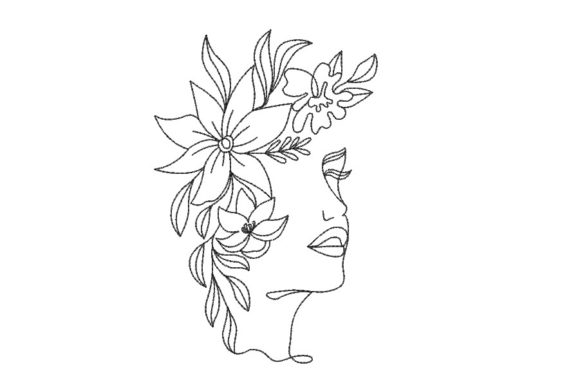
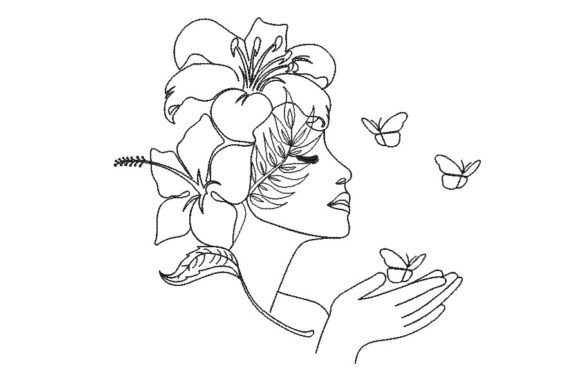
The first thing that strikes me about Woman and Flowers in One Line is its quiet confidence. It’s not loud or ornate—it’s a single, fluid contour line that traces a woman’s profile cradling blossoms like breath. There’s no fill-heavy florals or busy stems; just elegant negative space, intentional curves, and subtle organic rhythm. As a designer who’s stitched hundreds of motifs for boutique apparel and nursery decor, I immediately sense this isn’t a “fill-the-void” embroidery file—it’s a statement piece with breathing room. It leans into minimalism without sacrificing warmth, making it ideal for handmade products where craftsmanship and intention matter more than clutter.
Where It Lives Best: Real Projects, Real Reactions
Last week, I prepped a custom run of linen tea towels for a local kitchenware shop—and Woman and Flowers in One Line was my top pick for the front-center motif. Why? Because when stitched in soft ecru thread on natural flax, it read as both timeless and gently modern. Customers didn’t just say “pretty”—they paused, traced the line with their fingers, and asked, “Who drew this?” That’s the power of restraint done right. It works equally well on a lightweight cotton baby onesie (stitched with gentle satin stitch for smoothness), a structured canvas tote bag (where the clean line holds up against daily wear), or even a framed hoop for nursery wall art—no framing required, thanks to its self-contained balance.
What It Does for Your Craft Business—Beyond Aesthetics
For Etsy sellers and small shop owners, Woman and Flowers in One Line quietly elevates perceived value. Unlike dense floral clusters that can look mass-produced, this design feels hand-drawn and considered. When used on personalized gifts—say, a monogrammed sweatshirt with the motif subtly placed above the left chest—it adds emotional resonance without overwhelming the wearer’s identity. I’ve seen customers pay 20–30% more for items featuring similarly curated line-art embroidery because it signals care, not just capability. It also photographs beautifully in printable mockups: clean lines translate crisply across digital previews, helping buyers visualize the finished product before purchase.
Where Caution Is Warranted
This isn’t a one-size-fits-all embroidery file—and that’s a strength, not a flaw. Its delicacy means it demands thoughtful execution:
- Hoop size matters. Avoid cramming it into under-4” hoops—the curve of the shoulder and bloom placement need breathing room to resolve cleanly.
- Fabric texture changes everything. On terry cloth or heavy fleece, fine details may blur. Stick to smooth-weave fabrics like poplin, quilting cotton, or midweight linen for best clarity.
- Stretchy or thin fabrics require extra prep. Use cutaway stabilizer beneath knits or rayon blends, and consider a light tear-away on top to prevent thread pull-through on delicate silks or voiles.
- Dark fabric? Test contrast early. This design relies on line definition—not color pop—so matte black thread on charcoal fabric can disappear. Go for tonal contrast (e.g., charcoal thread on navy) or switch to a slightly shiny poly thread for lift.
- Caps and curved surfaces need simplification. The full motif may distort on a structured cap front. For commercial embroidery projects requiring caps, I recommend using just the floral element as a standalone accent—or resizing the entire design to fit within a 3.5” vertical constraint.
Design Integrity Meets Commercial Practicality
As someone who reviews embroidery files for both personal projects and client work, I appreciate how Woman and Flowers in One Line avoids over-engineering. There are no unnecessary satin-stitch petals or filler-heavy centers—just smart stitch density that balances coverage and drape. That means less thread breakage during long runs, smoother transitions on home machines, and cleaner results on budget-friendly embroidery software. It’s equally effective as an applique design (with raw-edge floral accents) or a pure line-work running stitch—giving craft business owners flexibility across product types without needing multiple versions.
Your Designer Checklist Before Stitching
- Test the machine embroidery design on scrap fabric *first*—especially if pairing with textured or dark materials.
- Review thread colors in natural light: does the line hold weight? Does it read clearly at arm’s length?
- Check whether the stitch density feels balanced—not so sparse it looks sketched, not so dense it stiffens the fabric.
- Confirm hoop size compatibility with your intended garment or item (e.g., a pillow cover may allow larger hooping than a baby onesie).
- Inspect small details under magnification: are flower tips crisp? Does the woman’s hairline flow without gaps or jumps?
- Run a black-and-white mockup to assess silhouette strength—this design lives or dies by its outline.
- Compare performance on light vs. dark backgrounds using your actual base fabric swatches.
- Use appropriate stabilizer: cutaway for stretch, tear-away for stable wovens, and fusible for lightweight linens.
- Verify licensing terms before selling finished products or listing the digital embroidery file—this is essential for Etsy sellers and digital product sellers.
Final Thought: Not Just an Embroidery File—A Design Decision
Woman and Flowers in One Line doesn’t shout. It invites. It’s the kind of embroidery design that makes customers linger at your booth, scroll slower on your Etsy listing, or choose your handmade product over a generic print. It fits seamlessly into the Beauty category—not because it’s decorative, but because it honors simplicity, femininity, and natural form without cliché. Whether you’re stitching holiday embroidery for a boutique gift set, developing a signature line for your craft business, or curating digital design assets for other makers, this motif earns its place through quiet precision. Just remember: its elegance depends on your attention to detail. Respect the line—and it’ll reward you with every finished product.