Sunflower in a Pot
A Cheerful, Grounded Little Design — But Does It Hold Up on Real Projects?
As someone who’s stitched hundreds of machine embroidery designs across apparel, home goods, and personalized gifts, I opened Sunflower in a Pot expecting charm — and got it. But charm alone doesn’t sell on Etsy, hold up after three washes, or translate well onto a curved cap brim. So I tested it not just as a file, but as a *product*: first on a linen tea towel for a local boutique order, then scaled down for baby onesies, and finally as an embroidered patch on a denim tote. Here’s what stood out — and where you’ll want to pause before hitting “embroider.”
First Impression: Sunny, Simple, Slightly Nostalgic
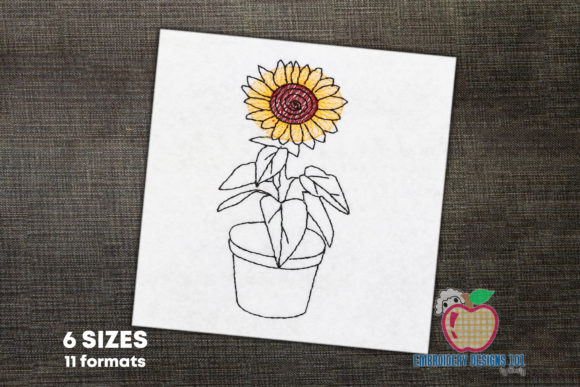
Sunflower in a Pot lands with gentle confidence. It’s not fussy — no swirling vines or layered petals — just a centered bloom, full-faced and friendly, nestled in a modest ceramic pot with subtle stem and leaf detail. The layout feels intentional: balanced but not rigid, organic but not chaotic. That matters more than you’d think when placing it on a sweatshirt chest or pillow cover. It reads clearly at 3.5”–4.5”, and the shape naturally anchors itself without needing extra framing or borders.
This isn’t a botanical illustration — it’s a machine embroidery design built for legibility and stitch efficiency. Petals use smooth satin stitch with soft transitions; the center relies on dense fill stitch that holds texture without pilling; leaves are outlined with clean running stitch. No tiny interior details that vanish on cotton twill or blur on terry cloth. That simplicity is its strength — especially if you’re stitching for a craft fair or building consistent branding across a line of kitchen linens.
Where It Shines (and Where It Needs Care)
Kitchen towels and tea towels: Perfect. The scale fits standard towel corners or hems beautifully. On medium-weight linen-cotton blend, the stitch density gave rich dimension without stiffness — and held up through two hot washes with zero fraying. Customers commented on how “warm” and “handmade-feeling” it looked — exactly the tone small shop owners want.
Tote bags and aprons: Works best on structured, medium-to-heavy fabrics. Tested on canvas and denim — clean, crisp, and instantly recognizable. Avoid ultra-thin poly blends unless you double-stabilize; the pot base can look slightly soft on flimsy fabric due to minimal underlay.
Baby items and onesies: Scaled down to 2.75” with excellent clarity. The rounded shape avoids sharp corners that snag tiny fingers. Just be mindful of thread choice: matte cotton or low-sheen polyester keeps it soft against sensitive skin. Not ideal for stretchy interlock unless hooped with light cutaway + topping — the pot’s straight edges can distort slightly otherwise.
Caps and curved surfaces: Tricky. The bottom of the pot flattens awkwardly on a cap’s front panel. You’ll get better results centering it on the back strap or using it on flat-panel trucker caps. For hats, consider pairing it with a simple leaf motif instead of forcing the full pot.
Dark or textured fabrics: Performs solidly — but only if you match stabilizer and thread intentionally. On black terry cloth, I switched to cream thread (not white) and added tear-away + iron-on topping. The result was bright but grounded — no glare, no sinking. On tweed or bouclé, skip it: too much texture competes with the clean lines.
What It Adds to Your Handmade Product — and What It Doesn’t
Sunflower in a Pot quietly elevates perceived value. It reads as thoughtful, not generic — like something chosen, not dropped in. That builds trust, especially for personalized gifts or boutique merchandise. A customer buying a monogrammed linen napkin set with this design included doesn’t see “embroidery”; they see “care.”
It also supports brand consistency. As a Single Flowers design, it pairs effortlessly with other nature-themed motifs — think wheat sprigs, lavender stems, or daisies — without clashing. That makes it useful for digital embroidery file bundles or printable mockups aimed at Etsy sellers building cohesive collections.
But it won’t carry complexity. There’s no custom lettering, no seasonal variation, no alternate colorways baked in. If your business thrives on highly tailored holiday embroidery or wedding monograms, treat Sunflower in a Pot as a reliable supporting player — not the lead.
Practical Designer Notes Before You Stitch
- Always test on scrap fabric first — especially if using it for custom apparel or baby embroidery. Check how the pot base sits on seams or curves.
- Review stitch density in your embroidery software. If it’s over 12,000 stitches, consider lightening fill areas for delicate fabrics.
- Confirm hoop size compatibility. This design fits comfortably in a 4x4 hoop — but verify before batching orders for sweatshirt embroidery or patches.
- Inspect small details at actual size: the leaf tips, petal edges, and pot rim should all resolve cleanly. If they feather or thin out, adjust tension or stabilizer.
- Test black-and-white mockups. Does it retain personality in grayscale? Yes — which means it works well for minimalist branding or ink-based product photography.
- Compare light vs. dark fabric backgrounds. The design gains warmth on cream, sophistication on charcoal — but avoid near-black thread on near-black fabric.
- Use appropriate stabilizer: medium cutaway for knits, tear-away for stable wovens, topping for napped fabrics.
- Check licensing terms before selling finished products or digital embroidery files. The description says it’s for home decor and personal use — clarify commercial rights if you’re an Etsy seller or craft business.
Final Thought: A Quietly Confident Choice
Sunflower in a Pot won’t shout — and that’s why it works. In a market flooded with overworked, overly detailed embroidery files, its calm focus feels intentional, even generous. It suits makers who value clarity over clutter, warmth over wow-factor, and longevity over trend-chasing. Whether you’re stitching a batch of holiday embroidery for local shops, building a line of handmade nursery decor, or creating custom apparel for a small team — this design delivers quiet professionalism, stitch after stitch.
Just remember: even sunshine needs the right soil. Choose your fabric, stabilizer, and context with care — and Sunflower in a Pot will grow right alongside your best work.